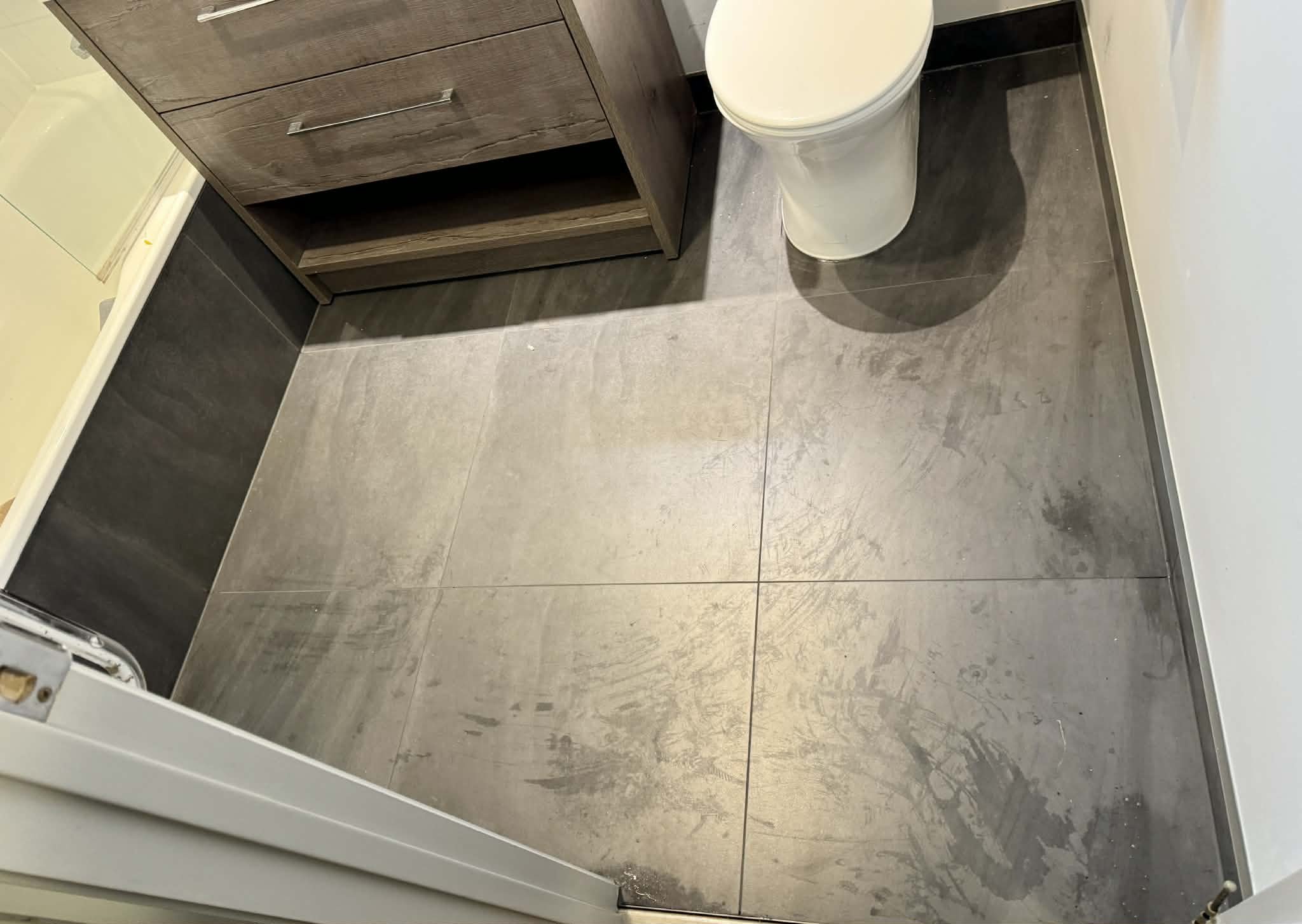
“The type of grout you choose can make a noticeable difference to the appearance, maintenance, durability, and cost of your finished tiled surface.”
When choosing tiles for a bathroom, kitchen, splashback, or floor, grout can seem like a small detail. However, the type of grout you choose can make a noticeable difference to the appearance, maintenance, durability, and cost of your finished tiled surface.
Two common options are cementitious grout and epoxy grout. Both can perform well when correctly selected and installed, but they have different characteristics and are suited to different applications.
In this guide, we explain the differences between epoxy and cementitious grout and what Auckland homeowners should consider when choosing between them.
What is Cementitious Grout?
Cementitious grout is a cement-based product and is one of the most commonly used types of grout for residential tiling.
Modern high-performance cementitious grouts are significantly more advanced than traditional cement grout. Depending on the product, they may include additives that improve water resistance, flexibility, colour consistency and resistance to mould or efflorescence.
One of its biggest advantages is that it is relatively straightforward to install and generally costs less than epoxy grout.
What Is Epoxy Grout?
Epoxy grout is a resin-based grout rather than a traditional cement-based product.
It normally consists of components that are mixed together immediately before application. Once cured, epoxy grout creates a dense, highly durable grout joint with very low water absorption.
Because of these properties, epoxy grout is often selected for areas where additional resistance to moisture, staining or chemicals is desirable.
Common applications include:
Showers and bathrooms
Kitchen splashbacks
Commercial kitchens
High-use wet areas
Mosaic installations
Areas where stain resistance is particularly important
However, epoxy grout is generally more expensive and considerably more labour-intensive to install than cementitious grout.
Epoxy vs Cementitious grout: What's the difference?
The main differences are durability, water absorption, stain resistance, installation and cost.
Water and moisture resistance
Cementitious grout is porous to varying degrees. Modern premium products can offer excellent performance in wet areas, but they are still cement-based materials.
Epoxy grout has very low water absorption and provides greater resistance to moisture entering through the grout joints.
However, there is an important distinction:
Epoxy grout does not replace waterproofing.
A shower or other tiled wet area still needs an appropriate waterproofing system beneath the tiles where waterproofing is required. Neither the tiles nor the grout should be relied upon as the primary waterproofing system.
Stain Resistance
This is one of the biggest advantages of epoxy grout.
Cementitious grout can absorb contaminants and may become stained over time, particularly in areas exposed to cooking oils, soap, cosmetics or other substances.
Modern high-performance cementitious grouts have improved stain resistance, but epoxy generally provides superior resistance because of its much lower porosity.
This can make epoxy particularly attractive for kitchen splashbacks, showers and other areas where easier cleaning is a priority.
Mould and Cleaning
Homeowners sometimes choose epoxy grout because they believe it will completely eliminate mould.
It can certainly help.
Because epoxy grout absorbs very little moisture and is highly resistant to staining, its surface can be easier to keep clean than traditional cementitious grout.
However, epoxy grout does not make a bathroom mould-proof.
Mould can still develop on surface contaminants, soap residue and silicone joints, particularly where bathrooms have inadequate ventilation or remain damp for long periods.
Good ventilation and regular cleaning remain important regardless of the grout used.
Durability
Both products can provide excellent service when the correct grout is selected and properly installed.
Epoxy grout generally offers greater resistance to:
Chemicals
Staining
Moisture
Abrasion
Heavy use
This is one reason it is commonly used in demanding commercial environments.
For a typical residential bathroom, however, a quality cementitious grout may provide all the performance required.
Choosing epoxy for every residential project is therefore not necessarily better or more cost-effective.
Why does Epoxy grouting cost more?
The difference isn't simply the price of the grout itself.
Epoxy requires a different installation process and generally takes considerably more labour.
Once its components are mixed, the installer has a limited working time. The grout needs to be applied and the tile surfaces carefully cleaned during the appropriate stages of the curing process.
If epoxy residue is allowed to harden on the face of the tiles, removing it can be extremely difficult.
This means the installer generally needs to work in smaller sections and carry out multiple cleaning stages.
The difference becomes particularly noticeable with mosaic and small-format tiles because there are substantially more grout joints to fill and clean.
For this reason, epoxy grouting a mosaic installation can take considerably longer than using cementitious grout.
At Cozy Tiling, we install both cementitious and epoxy grout systems for bathrooms, showers, kitchen splashbacks, mosaics and other tiled areas throughout Auckland.